Rua Augusta Arch
Arco da Rua Augusta
The Rua Augusta Arch (Arco da Rua Augusta) is the triumphal arch in the middle of the north side of Praça do Comércio, Lisbon, where Rua Augusta begins. Its rooftop viewpoint is open daily from 10:00 to 19:00, last entry 18:30. A ticket costs €5. A lift goes to the second floor, then 74 steps.
Updated
Rua Augusta Arch tickets and opening hours
Going up to the viewpoint costs €5, and the arch opens daily from 10:00 to 19:00. Last entry is at 18:30.
| Ticket | Price |
|---|---|
| Rua Augusta Arch | €5 |
| Children up to 5 | Free |
| With the Lisboa Card | Free |
| Arch and Lisboa Story Centre, adult | €11 |
The arch has one price for everyone. Children up to 5 go free, both at the arch and on the combined tickets.
Tickets are sold in the Lisbon tourist board’s online shop, which also sells the Lisboa Card.
The Lisboa Story Centre, in the east wing of the square, sells the combined tickets with the arch and with the Centro Interpretativo da História do Bacalhau, the cod history centre in the east tower.
How to go up the Rua Augusta Arch
You go in from Rua Augusta. A lift takes you to the second floor, and you climb the rest of the way on foot to the terrace on top of the arch.
Entrance
The entrance to the viewpoint is at no. 2 Rua Augusta, next to the arch.
Lift
The lift goes up to the second floor. From there to the top are 74 steps, so the viewpoint is not wheelchair accessible.
Clock room
Inside the arch, the Sala do Relógio (clock room) holds an exhibition on the history of the monument.
Terrace
At the top the view goes all the way round: the square and the River Tagus to the south, Rua Augusta and the Baixa to the north.
How long a visit to the Rua Augusta Arch takes
A visit to the arch takes about 30 minutes, according to the operator. The hours are the same every day.
How long
About 30 minutes at the arch. With the combined ticket, the Lisboa Story Centre takes another 70 minutes.
Light
The side with the statues and the inscription faces the square, to the south, and is in sunlight for most of the day. The clock is on the other side, facing Rua Augusta.
What the inscription on the Rua Augusta Arch says
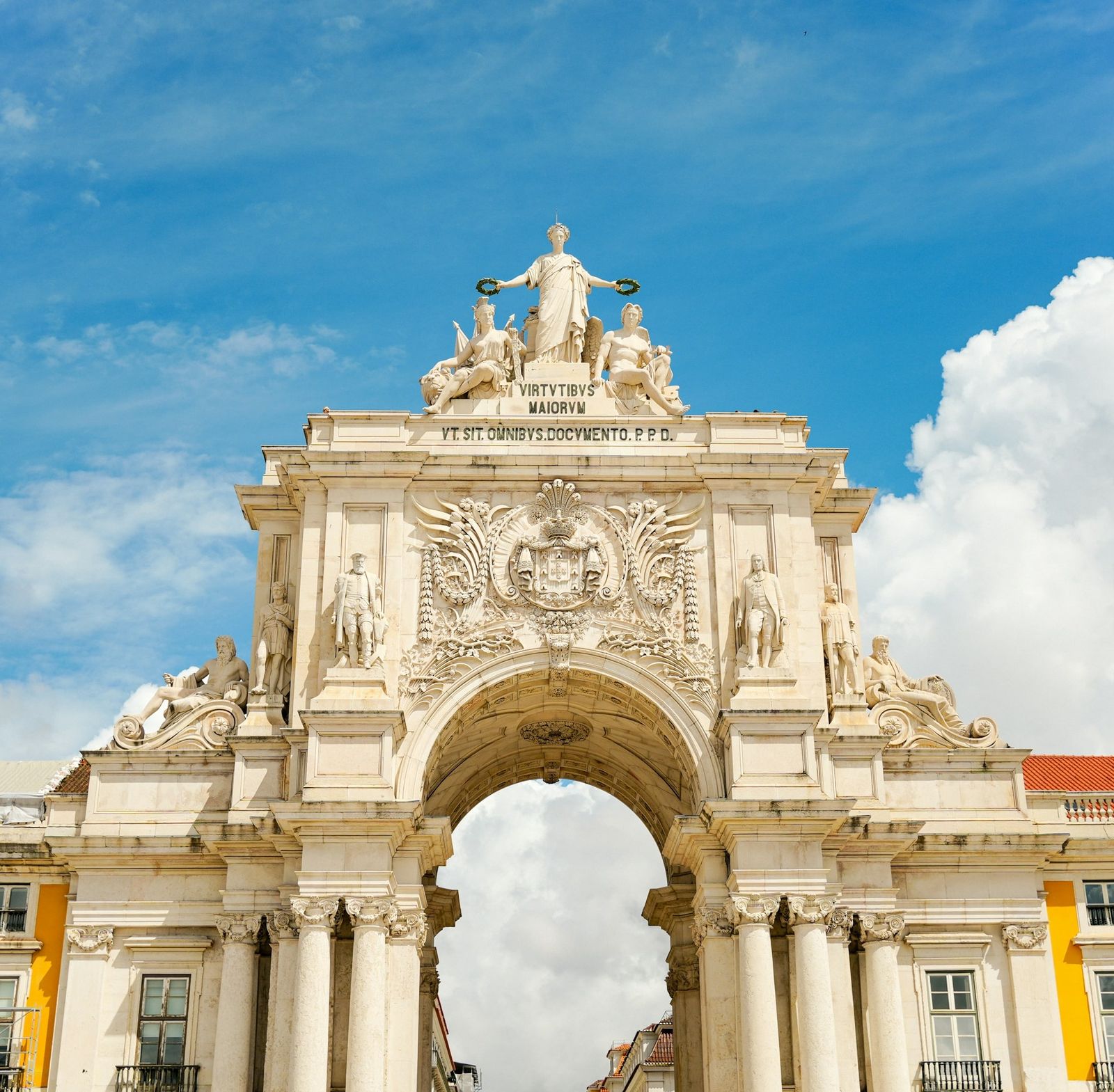
The Latin inscription, VIRTVTIBVS MAIORVM VT SIT OMNIBVS DOCVMENTO. P.P.D., means: "To the virtues of the ancestors, that they may be an example to all. Given by public subscription."
The words are on the side facing the square, below the group of statues on top. The letters are made of iron.
The last three letters, P.P.D., stand for pecunia publica datum: the arch was paid for with public money, by subscription.
The "maiores" of the inscription are the ancestors. Lower down, Vítor Bastos’s statues show four figures from Portuguese history.
Who the statues on the Rua Augusta Arch are
On top, Glory crowns Genius and Valour, a group by Célestin Anatole Calmels. Below, Vítor Bastos carved Vasco da Gama, the Marquis of Pombal, Viriato and Nuno Álvares Pereira, and the rivers Tagus and Douro.
| Sculpture | Where | Sculptor |
|---|---|---|
| Glory crowns Genius and Valour | On top, above the inscription | Célestin Anatole Calmels |
| Vasco da Gama and the Marquis of Pombal | On the columns either side of the opening | Vítor Bastos |
| Viriato and Nuno Álvares Pereira | On the outer columns | Vítor Bastos |
| The rivers Tagus and Douro | Reclining on the side sections | Vítor Bastos |
Glory is a young woman, beside a lion and military standards. Genius is a winged youth holding books and a lyre. The two rivers are mature, bearded men.
Above the opening of the arch is the royal coat of arms, with a crown.
The clock on the Rua Augusta Arch
The clock is on the north side, facing Rua Augusta, in the place the royal arms hold on the square side. It came to the arch in the 1930s.
During the Second World War the clock had a siren mechanism to warn the city of air raids.
The hands are copper, with an aluminium reinforcement. The minute hand is 2.60 m long and the hour hand 2.2 m. They were taken down for restoration and went back on the clock on 29 May 2025.
History of the Rua Augusta Arch, 1759 to 1875
The arch was part of the plan for rebuilding the Baixa after the 1755 earthquake, but it was only finished more than a century later.
1759
The rebuilding plan includes an arch at the entrance to Rua Augusta, designed by Eugénio dos Santos.
1775
When the statue of King José I is unveiled on 6 June, work on the first arch has already begun.
1777
With the accession of Maria I and the fall of the Marquis of Pombal, that arch is pulled down.
1815
The columns are put up and stand for decades without a top.
1843
A competition opens for the design of the arch.
1844
The design by the architect Veríssimo José da Costa is chosen.
1873
Building starts on the arch you see today, with sculptures by Calmels and Vítor Bastos.
1875
The arch is finished.
2013
On 9 August the viewpoint on top opens to the public.
Frequently asked questions
How much does it cost to go up the Rua Augusta Arch?
A ticket for the viewpoint costs €5, one price for everyone. Children up to 5 go free, and so do holders of the Lisboa Card. The combined ticket with the Lisboa Story Centre costs €11 for an adult. A visit to the arch takes about 30 minutes.
Is there a lift in the Rua Augusta Arch?
Yes, but only to the second floor. From there to the terrace on top are 74 steps, so the viewpoint is not wheelchair accessible. The square is flat, and the statues and the inscription are easy to see from the ground on the square side.
What time does the Rua Augusta Arch open?
The viewpoint opens daily from 10:00 to 19:00. Last entry is at 18:30, half an hour before closing. As the visit takes about 30 minutes, anyone going in at the last entry still has time for the clock room and the terrace.
What does the inscription on the Rua Augusta Arch mean?
The Latin inscription, VIRTVTIBVS MAIORVM VT SIT OMNIBVS DOCVMENTO, means "to the virtues of the ancestors, that they may be an example to all". The letters P.P.D. at the end say that the arch was paid for by public subscription. The words are on the side facing the square, below the statues on top.
When was the Rua Augusta Arch built?
The arch you see today was built between 1873 and 1875 to a design by Veríssimo José da Costa. It had been planned since 1759, in the rebuilding after the earthquake. A first arch was pulled down in 1777, and the columns put up in 1815 stood for decades without a top.